SEO almost never breaks loudly. A deploy ships a stray noindex, a plugin update rewrites titles, a canonical points somewhere absurd, and the site looks perfectly fine while Google quietly walks away.
The defense is an alarm layer that watches the signals for you. Here is the three-layer setup, cheap to build and boring to run, which is the point.
What actually breaks, silently
| The break | How it happens | What Google does |
|---|---|---|
| Stray noindex | Staging setting ships to production | Drops the page on next crawl |
| robots.txt block | A deploy or CDN config change | Stops crawling the section |
| Canonical gone wrong | Plugin or template update | Credits the wrong URL |
| Titles overwritten | An SEO plugin's defaults take over | Re-evaluates every snippet |
| Schema stops validating | A markup change breaks the JSON | Pulls your rich results |
| SSL or domain lapse | A renewal nobody owned | Users and crawlers bounce |
Every row shares the same property: the page still renders. Eyes cannot catch these; only checks can.
Layer 1: turn on Google's own warnings
In Search Console, confirm email notifications are on for every owner. Manual actions, security issues and some indexing errors will email you, and those mails outrank everything else in your inbox.
Know the layer's limits: it reports what Google noticed, on Google's schedule, usually days after the fact. It is the coroner's report, valuable and late.
Layer 2: a monitor that checks your pages directly
The Website Monitor from the Keywords Everywhere team watches the SEO signals themselves: whether pages stay indexable, whether schema stays valid, plus uptime every 10 minutes, SSL expiry and domain expiry, free, with setup genuinely under a minute.
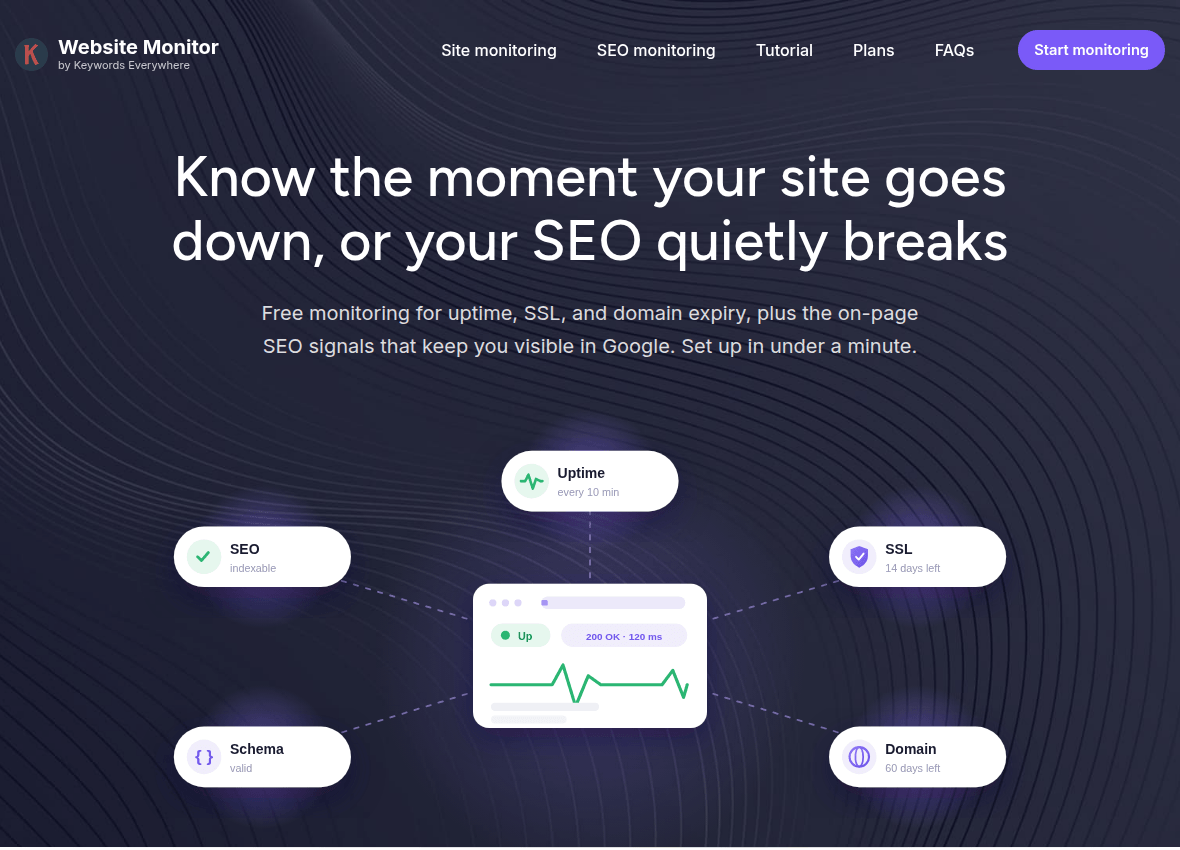
This is the layer that converts silent breaks into same-day emails: the noindex that shipped Friday afternoon becomes a Friday alert instead of a Monday-two-weeks-later mystery.
Point it at the pages that matter: money pages plus one representative per template. Template breaks surface on the representative, and a short list keeps every alert meaningful.
Layer 3: guard the deploys
Most silent breaks are self-inflicted at deploy time, so the third layer is process: a pre-release glance at robots.txt, the meta robots line and the canonical on one page per template. Thirty seconds per deploy prevents most of the alerts the monitor would otherwise send.
The monitor stays anyway, because process fails exactly when everyone is busy, which is also when deploys happen.
Why detection speed is the whole game
The response runbook
When an alert fires: verify the change is real (open the page source, check the flagged signal), find the source (the deploy log, the plugin update, the CMS setting changed that day), revert it, then request recrawling of the affected URLs in Search Console.
Afterward, watch the recovery through your GSC views rather than refreshing rankings hourly: reindexing takes days, and the settling wobble is normal. If positions have not begun returning in two weeks, the revert missed something; audit the page against its pre-break snapshot.
And log every incident with its cause. Three alerts traced to the same plugin is not bad luck, it is a decision waiting to be made.
The one-line takeaway: SEO breaks ship silently with deploys and updates, so build the alarm layer: GSC's emails on, a monitor like Website Monitor watching indexability, schema, uptime and expiries on your key pages, and a thirty-second deploy check. Detection speed decides whether a break is a dent or a crater.