Rank tracking produces data. Decisions come from three derived reports: what is almost winning, what is quietly dying, and what is fighting itself. Everything else in a ranking tool is scenery.
Here is what each report means, how to pull it from your own Search Console data by hand, and the automatic route.
The three lenses on one dataset
Report 1: quick wins
A keyword at position 8 with a thousand impressions is Google saying "convince me". The page already qualified; it just is not winning yet.
The manual recipe: Performance report, filter position greater than 4 and less than 16 in the export, sort by impressions. Everything at the top of that list is one content improvement away from the traffic cliff between page two and page one.
The push that works: expand the section matching the query's intent, add the query's phrasing to title or headings where natural, and point two or three internal links at the page from related articles.
Report 2: content decay
Decay is not a drop; it is a slope. The page that earned 900 clicks in March, 780 in April, 650 in May, while nothing broke and nobody noticed.
The manual recipe: Pages tab, compare the last 3 months with the previous 3, sort by click decline. Read the fallers with one question: did demand fall, or did we? A seasonal topic sagging in the off-months is fine; an evergreen page sliding while its keyword holds volume is decay.
The fix, in order of power: update the substance (numbers, screenshots, the current year's reality), re-answer the query better than the newer competitors do, and re-link it from your recent content so it stops looking abandoned.
Report 3: cannibalization
When two of your URLs both chase one query, Google alternates them, each accumulates half the signals, and both underperform a single committed page.
The manual recipe: filter to one important query, open the Pages tab, and count URLs. Two or more with meaningful impressions is the disease; the position graph wobbling as they swap is the symptom.
The triage: merge the pages if they serve one intent, differentiate them hard if they truly serve two, and either way pick one canonical winner for the query and point the internal links at it.
The automatic route
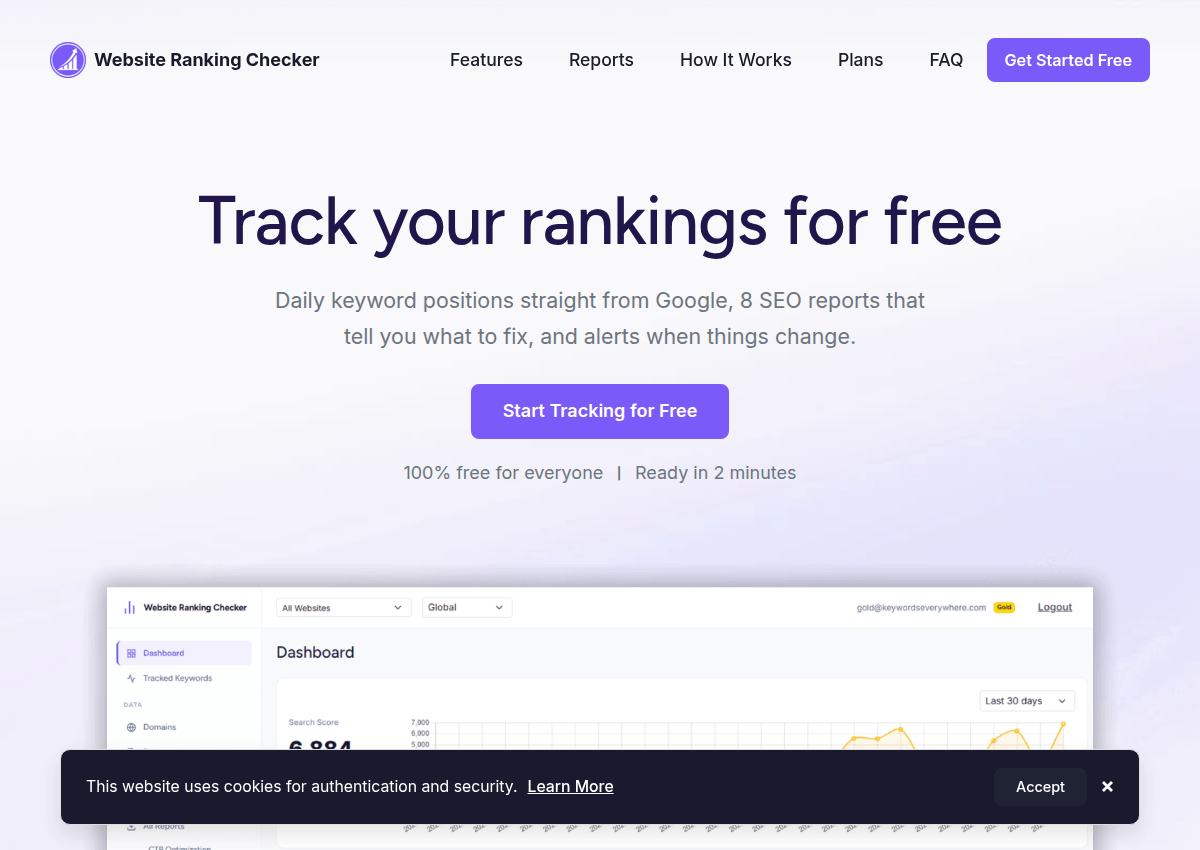
All three recipes are filters on your own Search Console data, which means they can run themselves. The Website Ranking Checker from the Keywords Everywhere team connects to your Search Console and generates exactly these reports: quick wins, decay and cannibalization, from your real Google data.
Hand-built or generated, the reports only pay when the outputs become edits. A report nobody acts on is rank tracking with extra steps.
The monthly hour
| Minutes | Report | Output |
|---|---|---|
| 0-20 | Quick wins | 3 pages to push this month |
| 20-40 | Decay compare | 2 pages to refresh |
| 40-60 | Cannibalization sweep | Any collisions to resolve |
Five edits a month, chosen by evidence instead of vibes, and driven by the same Search Console fundamentals underneath. That cadence outperforms most content calendars, because every edit starts from proof.
The one-line takeaway: quick wins are one push from page one, decay is caught on the slope or not at all, and cannibalization is your pages funding each other's failure. Run all three monthly, by hand from GSC or generated by the Website Ranking Checker, and turn the outputs into edits.